Product review · September 2026
The Vatrer 12V 100Ah Group 24 drops straight into an existing battery tray, which is most of its appeal. The harder question is how many of them your rig actually needs — and that is arithmetic, not opinion.
01 Why the size matters
Battery group sizes are a standard set of physical dimensions. Your RV, travel trailer or boat already has a tray, a box and hold-downs built for one. A Group 24 lithium battery drops into a Group 24 space — no rebuilding the compartment, no fabricating a new mount, no re-running cable to somewhere else.
That matters more than it sounds. The reason plenty of people never get round to switching from lead-acid is not the battery cost, it is the afternoon of work around it. This removes that afternoon.
Check what is in your tray now. If it says Group 24, this is a straight swap. If it says Group 27, 31 or 8D, the footprint is different — Vatrer sells other sizes, and this page is not about those.
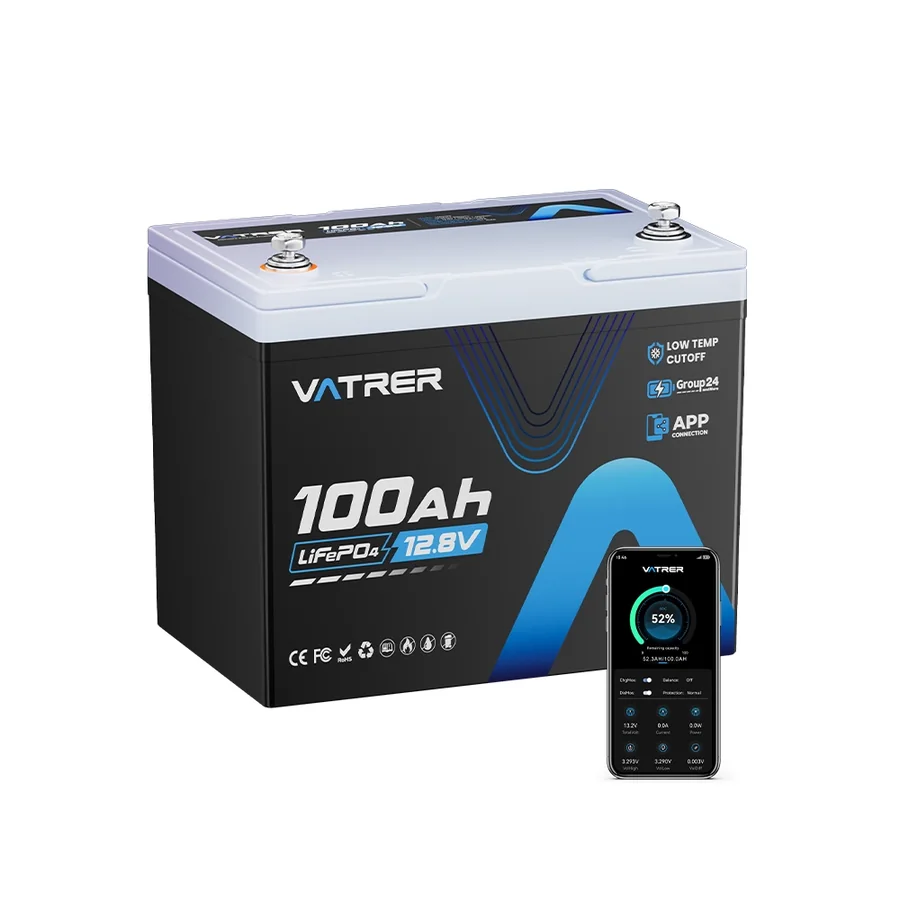
The Group 24 case — the same footprint your existing tray was built around.
02 How many?
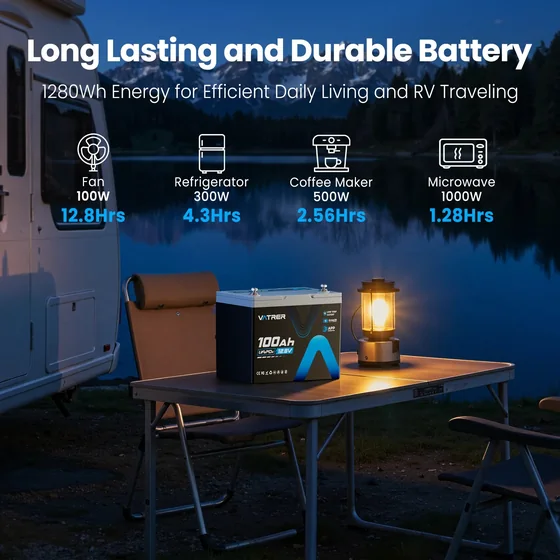
Set the hours per day you run each thing. The wattages are typical figures for 12V RV and marine gear — change them if you know your own. It runs in your browser and sends nothing anywhere.
Planning figure only. We size against 90 Ah usable of the 100 Ah rating rather than the full label, because planning a bank to exactly 100% leaves you no margin for a cold night, an ageing cell or a load you forgot. Real draw varies with temperature, how hard the fridge works and how the inverter is loaded.
03 What the specs mean
These are Vatrer's published figures. What follows is what each one actually changes for you.
The BMS caps how much current the battery will deliver. At 12V, 150A is roughly 1,800 W of instantaneous draw — enough for a mid-size inverter running a microwave or a coffee maker while the fridge is going. Plenty of cheaper 100Ah batteries stop at 100A, which is where surge loads trip them.
This is a feature, not a fault. Charging LiFePO4 below freezing plates lithium on the anode and permanently damages the cells. The BMS blocks it. What that means in practice: on a winter morning the battery will run your loads but not accept solar until it warms up. If you camp in real cold, the self-heating models exist for exactly this reason.
IP65 means sealed against dust and protected against water jets. Vatrer also describes the housing as moisture and salt-spray resistant, which is the relevant claim for a boat locker. It does not mean you can drop it in the lake.
The Vatrer app reports state of charge, voltage, current and temperature. The practical value is not the gadget factor — it is knowing on the second night whether you have enough left for the fridge, without pulling up the bed frame to reach a shunt.
04 Pack pricing
Vatrer sells this in 1, 2, 4 and 10 packs. It is worth doing the division before assuming the bigger pack is the better deal.
| Pack | Total | Per battery | Saving vs single |
|---|---|---|---|
| 1 pack | $259.99 | $259.99 | — |
| 2 pack | $519.99 | $260.00 | $0.01 more per battery |
| 4 pack | $1,029.99 | $257.50 | $2.49 each — under 1% |
| 10 pack | $2,569.99 | $257.00 | $2.99 each — about 1.1% |
So the 2 pack costs a cent more per battery than buying two singles, and the biggest pack saves just over one percent. Buy the pack that matches the number you worked out above, and do not talk yourself into a larger one on the assumption it is cheaper per unit. It is not, in any way that matters.
05 Full specifications
| Price | $259.99 for a single battery |
|---|---|
| Chemistry | LiFePO4 (lithium iron phosphate) |
| Nominal | 12V, 100Ah |
| Case size | Group 24 — direct fit for lead-acid and AGM trays |
| BMS | 150A Smart BMS |
| Low-temp protection | Charging stops below 32°F to protect the cells |
| Housing | IP65 ABS; moisture and salt-spray resistant |
| Monitoring | Bluetooth + Vatrer app — state of charge, voltage, current, temperature |
| Charging options | LiFePO4 AC charger, solar via MPPT controller, generator or DC-to-DC charger |
| Intended use | RVs, travel trailers, boats, trolling motors, cabins, off-grid |
| Pack options | 1, 2, 4 and 10 — see the pricing note above |
From Vatrer's published product information, checked September 2026. Prices change during sales — confirm before ordering.
06 The other side
07 FAQ
Physically, if your tray is Group 24, yes. Electrically there is one thing to check: your charger. Lead-acid and AGM chargers use different voltage profiles, and some older converters will not charge LiFePO4 properly. A lithium-capable charger or a DC-to-DC charger solves it.
Because planning a bank to exactly its label leaves no margin. Cold reduces available capacity, cells age, and there is always a load you did not count. The 10% buffer in the calculator is deliberate — if you want to size to the full 100Ah, the arithmetic is on the page and you can redo it.
The three things worth paying for here are the 150A BMS rather than 100A, the Bluetooth monitoring, and the IP65 housing. If you are running a small load with no inverter and you can see the battery easily, a cheaper unit may genuinely be enough.
It will discharge — your lights and fridge keep running. It will not charge below 32°F, because the BMS blocks it to stop permanent cell damage. On a frosty morning that means solar will not top it up until things warm. If that is your normal weather, buy a self-heating model.
Barely. $257.00 each against $259.99 for a single — about 1.1%. And the 2 pack is actually a cent more per battery than buying two singles. Buy the quantity you need, not the pack that looks like a bulk deal.
No, and we would rather say so. Every specification here comes from Vatrer's published product information. The only original working on this page is the sizing calculator, which is arithmetic on wattages and hours you can change yourself — and the pack-pricing division, which you can check with a calculator in ten seconds.
One battery too few means a dead fridge on night two. One too many is $260 sitting in a locker. The calculator takes a minute.