Product review · September 2026

3000 watts out means 276 amps in

This is a competent, well-protected pure sine wave inverter for $259.99. It is also the piece of equipment people most often buy without checking whether their battery can feed it — and on the batteries we have reviewed here, it cannot.

This page contains affiliate links. If you buy through one we may earn a commission at no extra cost to you. It does not change what this page says.
$259.993000 W continuous · pure sine wave · 12 V DC to 110/120 V AC
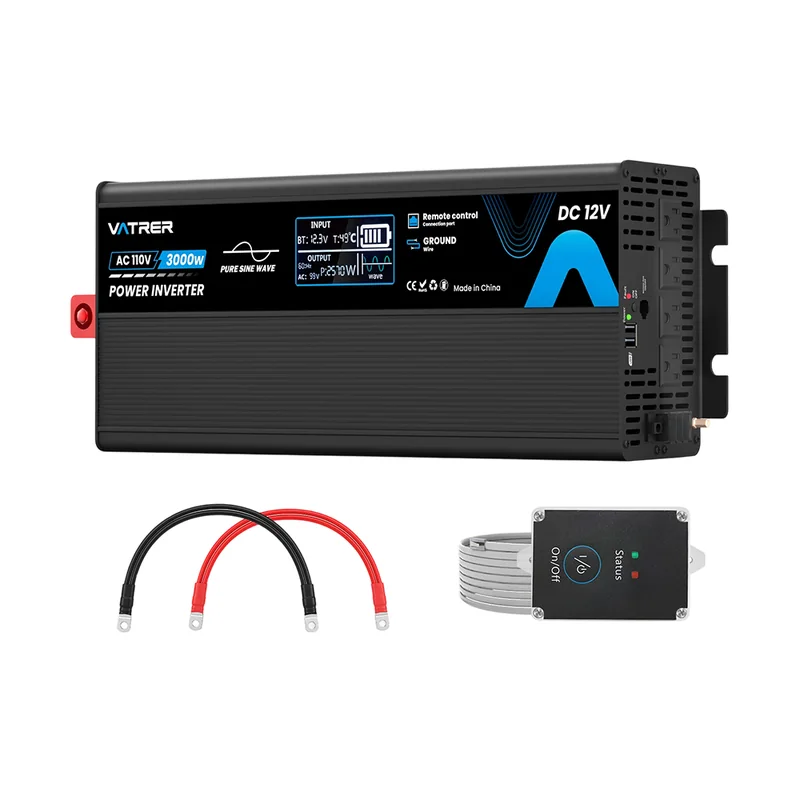
Vatrer 3000 watt pure sine wave inverter
3000 WContinuous, pure sine wave
~276 ADC draw at full load, 85% efficiency
85–95%Conversion efficiency Vatrer publishes
6Protection circuits built in

01 The catch

Neither battery on this site can run it flat out

We would rather lead with this than bury it. The inverter is fine. The problem is what it asks of whatever is behind it, and that is arithmetic anyone can check.

276 A

Watts in must exceed watts out. 3000 W of AC output, drawn from a 12.8 V battery at Vatrer's lower published efficiency figure of 85%, needs 3000 ÷ 0.85 ÷ 12.8 ≈ 276 amps of DC current. At 95% efficiency it is still about 247 A.

A battery's BMS caps how much current it will deliver, and that cap is a hard limit, not a suggestion. Here is where that leaves the two packs we have written up:

Battery BMS limits against a 3000 W inverter
BatteryBMS limitMax AC it can supportEnough for 3000 W?
12V 100Ah Group 24 150 A~1,632 W No — about 54%
12V 300Ah, 200A BMS 200 A~2,176 W No — about 73%
What 3000 W actually needs ~276 A3,000 W —

This does not make the inverter a bad product. It makes 3000 W a rating, not a promise. Run it at 1,500 W on the 100Ah or 2,000 W on the 300Ah and it works exactly as intended, with headroom for surges. Ask it for its full label and the battery cuts out first.

The real fixes are two batteries in parallel, which doubles the available current, or a 24 V system, where the same watts draw half the amps. Both are bigger decisions than buying an inverter.

02 What can it run?

Put your actual load in

Enter the wattage of the thing you want to power. This works out the DC current it demands and checks it against each battery's published BMS limit. It runs in your browser and sends nothing anywhere.

Rough figures: coffee maker 900 W · microwave 1,000–1,200 W · induction hob 1,800 W · hair dryer 1,500 W · laptop 65 W · TV 50–100 W. Motors and compressors surge well above their rating on startup.

DC current needed at 12.8 V, 85% efficiency—

See current price →

Planning figures. We use 85% efficiency — the bottom of Vatrer's published 85–95% range — because sizing to the optimistic end of a range is how people end up with a system that trips. Surge current on motor loads is higher still and is not modelled here.

03 The detail

What the inverter itself gets right

Pure sine wave, and why it matters

An inverter turns DC into AC, and there are two ways to do it. A modified sine wave is a cheap approximation — a stepped waveform that runs a kettle fine and makes sensitive electronics unhappy. Pure sine wave output closely matches household grid power, which is what Vatrer specifies here.

Vatrer names the loads this protects: laptops, TVs, routers, LED lighting, microwaves and motor-driven tools. The practical version is that anything with a switching power supply or a motor speed controller would rather have a clean waveform, and some of it will buzz, run hot or refuse outright on a modified one.

85–95% efficient — and where the rest goes

Vatrer publishes conversion efficiency of roughly 85 to 95%. The missing 5–15% becomes heat. That has two consequences worth planning for: you lose that share of your battery capacity before the appliance sees a watt, and the inverter needs air around it.

Six protections, which is the part you do not see

Undervoltage, overvoltage, overload and overcurrent, short circuit, over-temperature and reverse polarity. That last one matters more than it sounds — connecting a large inverter backwards is an expensive mistake that a protection circuit turns into an inconvenience.

Vatrer states these are there to protect connected devices as well as the inverter itself, which is the right way round for anything you are plugging a laptop into.

Where it sits

Vatrer positions it for off-grid homes, RVs, solar systems and emergency backup. That is a fair list. It is not a portable power station — it is a component you wire into a system that already has a battery, and the quality of that system decides whether the inverter performs.
04 Specifications

Published figures, September 2026

Vatrer 3000W inverter specifications
Price$259.99
Continuous output3000 W
WaveformPure sine wave
Input12 V DC
Output110 V / 120 V AC
EfficiencyApproximately 85–95%
ProtectionsUndervoltage, overvoltage, overload, overcurrent, short circuit, over-temperature, reverse polarity
Intended useOff-grid homes, RVs, solar systems, emergency backup
DC draw at full load~276 A at 85% efficiency — our arithmetic, not Vatrer's figure

From Vatrer's published product information, checked September 2026. The DC draw figure is ours, derived from their output and efficiency numbers — you can redo it in one line.

05 The other side

When this is the wrong inverter

Skip it if

  • You have one 100Ah battery. Its 150 A BMS supports about 1,632 W. A 1000 W inverter would cost less and match the system.
  • You only run small loads. A big inverter idles at a higher standby draw than a small one; oversizing costs you battery every hour it is switched on.
  • You wanted a portable power station. This is a component to wire in, not a box with sockets on it.
  • You need the full 3000 W. Then you need two batteries in parallel or a 24 V system first. Buy the battery side before the inverter.

Buy it if

  • You have a 300Ah pack, or plan to. 200 A of BMS headroom makes a 2,000 W working load comfortable.
  • You run sensitive electronics. Pure sine wave is the whole reason to pay more than the cheapest inverter on a marketplace.
  • It is emergency backup. Occasional high loads, mostly idle, protections that matter when it is dark and nobody is watching.
  • You want headroom for surges. Running a 3000 W unit at 1,500 W leaves room for a compressor kicking in.

06 FAQ

Questions worth answering

Can I run this on the 12V 100Ah battery?

Not at its rating. That battery's BMS caps at 150 A, which is about 1,632 W of AC output at 85% efficiency — roughly 54% of what the inverter claims. It will run smaller loads perfectly well; it will not deliver 3000 W, and the battery will cut out before the inverter complains.

What about the 300Ah battery?

Better, still short. A 200 A BMS supports about 2,176 W. That covers a microwave, a coffee maker or most power tools comfortably. It does not cover the full label.

So is the 3000W rating dishonest?

No — it is what the inverter can convert. The constraint is on the battery side, which is a different component. Our point is only that the two numbers have to be checked together, and the marketing for each is written as if the other did not exist.

Is pure sine wave worth the extra over modified?

If you are running laptops, TVs, routers, anything with a motor speed controller, or medical equipment — yes. If you are running a kettle and incandescent lights, you will not see the difference. Most people own some of the first category.

How much capacity does the conversion cost me?

Between 5% and 15% of every watt-hour, per Vatrer's published efficiency range. Plan against the low end: assume 15% goes to heat rather than to your appliance.

Did you test it?

No, and we would rather say so. Every specification here is Vatrer's published figure. The 276 A draw is our own arithmetic on their output and efficiency numbers, shown in full so you can check it — and the BMS limits come from the battery pages on this site.

The other reviews on SalePilot

An inverter is only as good as what is behind it. Here is what is behind it.

12V 100Ah Group 24 — $259.99 300Ah Dual Purpose — $569.99 300Ah Self-Heating — $629.99