Product review · September 2026
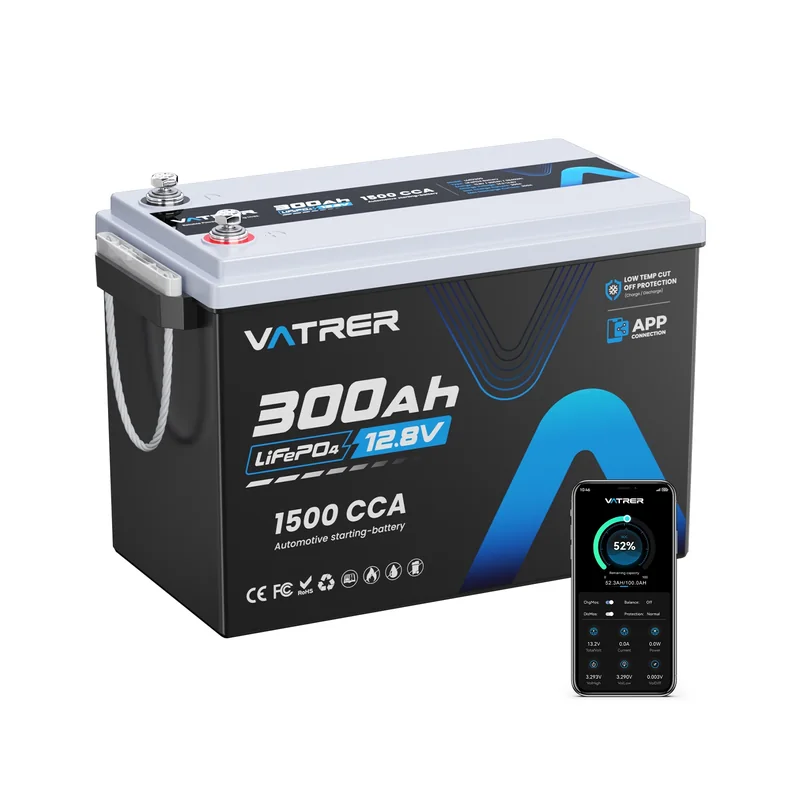
Most boats carry two batteries: one to start the engine, one to run everything else. This is Vatrer's attempt to make that one battery — 1500 CCA of starting current alongside 3,840 Wh of deep-cycle capacity.
01 What "dual purpose" means
A starting battery delivers a huge burst of current for a second or two and is then recharged by the alternator. A deep-cycle battery delivers a modest current for hours and is designed to be run down and refilled. They are built differently, and asking one to do the other's job usually ends badly.
1500 CCA is the starting half. Cold cranking amps measure what a battery can deliver at 0°F for 30 seconds — the number that decides whether an engine turns over on a cold morning. 300 Ah / 3,840 Wh is the deep-cycle half, which is what runs the fish finder, the pumps, the lights and the navigation gear once the engine has started.
Vatrer's pitch is that this replaces the two-battery setup with one, and for a boat where space and weight are both scarce, that is a real argument.
The 200 A BMS handles overcharge, over-discharge, over-current, short circuit and temperature. Charging stops below 32°F and resumes automatically once the battery comes back into a safe range — the same protection as the smaller pack we reviewed, and the same practical consequence: on a freezing morning it runs your loads but will not accept a charge.
If that is a problem where you keep the boat, the self-heating version exists for $60 more and solves precisely this.
02 How long?
Capacity in watt-hours means nothing until you divide it by what you run. Set the hours and this works out how long this pack lasts, and how long the 100Ah would have. It runs in your browser and sends nothing anywhere.
Planning figures only, sized against 90% of rated capacity rather than the full label, for the same reason as our other calculators: planning to 100% leaves no margin for cold, for cell ageing or for a load you forgot. Air conditioning through an inverter also loses 5–15% to conversion, which is not modelled here.
03 Pack pricing
Same pattern we found on the 100Ah. Worth doing the division rather than assuming the bigger box is the better deal.
| Pack | Total | Per battery | Saving vs single |
|---|---|---|---|
| 1 pack | $569.99 | $569.99 | — |
| 2 pack | $1,137.99 | $569.00 | $1.00 each — 0.2% |
| 4 pack | $2,271.99 | $568.00 | $2.00 each — 0.4% |
| 10 pack | $5,669.99 | $567.00 | $3.00 each — 0.5% |
Buying ten saves you $30 across $5,670. Buy the number you need — there is no bulk argument here, and two of these in parallel is a real decision about your electrical system rather than a way to save money.
04 Specifications
| Price | $569.99 for a single battery |
|---|---|
| Chemistry | LiFePO4 |
| Nominal | 12.8 V, 300 Ah — 3,840 Wh |
| Cold cranking | 1500 CCA |
| BMS | 200 A, continuous discharge |
| Cells | Grade A, with auto cell balancing |
| Protections | Overcharge, over-discharge, over-current, short circuit, temperature |
| Low-temp behaviour | Charging stops below 32°F, resumes automatically |
| Weight | 55.23 lb |
| Charging | LiFePO4 AC charger, solar with MPPT, or generator with DC-to-DC charger |
| Intended use | Marine, RV, off-grid — starting and house loads |
| Pack options | 1, 2, 4, 10 — see the pricing note above |
From Vatrer's published product information, checked September 2026.
05 The other side
06 FAQ
That is what dual purpose means, and 1500 CCA is a serious cranking figure. The caveat is the same as with any single-battery setup: if you run the house loads flat, you have also run your starting battery flat. Plenty of people accept that trade for the space saving; plenty of others keep a separate starter for exactly that reason.
$60 and one feature. This one stops charging below 32°F and waits. The heated version routes incoming charge to a heater first, warms the cells, then charges normally. If you never see freezing temperatures, the $60 buys you nothing.
By $3.00 each — about half a percent. Buy the number you actually need.
Through an inverter, briefly. A 700 W air conditioner draws about 64 A from the battery before inverter losses, which is inside the 200 A BMS limit — but at that rate the pack's usable 3,456 Wh lasts roughly five hours with nothing else running. Put the numbers into the calculator above with your own hours.
No, and we would rather say so. Every specification here is Vatrer's published figure. The runtime and pack-price arithmetic is ours, and both are shown in enough detail to check.
Four components of the same system, written up one at a time.