Product review · September 2026

The $60 that buys you a charge on a frozen morning

Every other LiFePO4 battery on this site refuses to charge below 32°F. This one warms itself up first and then charges. Whether that is worth $60 over the standard 300Ah comes down to one question about where you keep it.

This page contains affiliate links. If you buy through one we may earn a commission at no extra cost to you. It does not change what this page says.
$629.99300Ah / 3.84 kWh · 200A BMS · 2,560 W output · self-heating
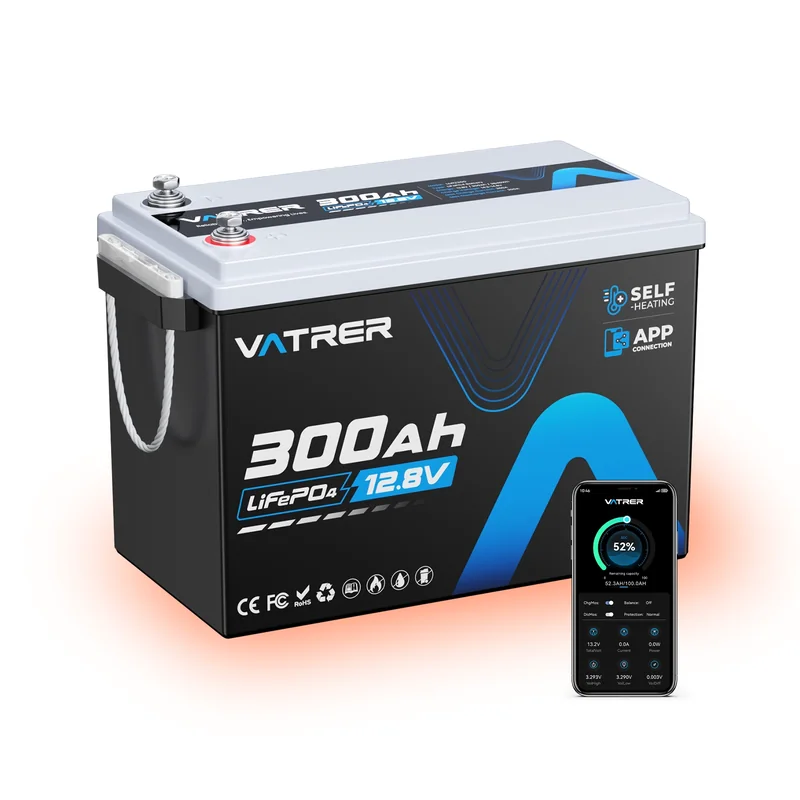
Vatrer 12V 300Ah self-heating LiFePO4 battery
32°FBelow this, charge goes to the heater first
41°FAbove this, heating stops automatically
2,560 WContinuous output from the 200A BMS
+$60Over the standard 300Ah

01 The heater

What it actually does, in order

This is the whole product. Everything else about it matches the standard 300Ah, so the $60 buys exactly one behaviour — and it is worth understanding precisely rather than vaguely.

32→41°F

Charger connected, cells at or below 32°F: the BMS sends the incoming charge to the heating element instead of to the cells. Nothing charges yet; the battery is warming itself with your solar or shore power.

Cells above 41°F: heating stops and normal charging begins automatically. No switch, no app, no intervention.

The point is that you leave the battery installed through winter and the system handles the warm-up before your solar, shore power or vehicle charging replenishes it.

What happens without a heater

  • The battery still runs your loads in the cold — discharge is not blocked.
  • It will not accept a charge until it warms up on its own.
  • On a short winter day, that can mean missing the solar window entirely — the sun is up while the battery is still too cold, and by the time it has warmed, the sun is going.
  • Over a cold week that compounds: you are discharging daily and charging rarely.

What the $60 does not buy

  • Not more capacity. Both are 300 Ah / 3,840 Wh.
  • Not more output. Both use a 200 A BMS.
  • Not cranking power. The marine version has 1500 CCA; this one is not sold on that.
  • Nothing at all if your battery never sees 32°F. In a garage in Florida this is $60 for a feature that will not activate.

02 How long?

Runtime on your actual loads

3.84 kWh means nothing until you divide it by what you run. Set the hours and this works out how long this pack lasts, and how long the 100Ah would have. It runs in your browser and sends nothing anywhere.

LoadHrs/dayWh/day
12V fridgeTypical 45 W while running —
LightsTypical 15 W —
Water pumpTypical 60 W while running —
Electronics chargingTypical 45 W —
TV or entertainmentTypical 50 W —
Heater or air conditioningTypical 700 W — via inverter —
Daily consumption—
This battery — 3,840 Wh—
The 100Ah — 1,280 Wh—

See current price →

Planning figures, sized against 90% of rated capacity. In genuinely cold weather expect less — the heater itself draws from your incoming charge, and cold reduces available capacity regardless of chemistry.

03 Pack pricing

Again, about half a percent

The same pattern as every other Vatrer product we have looked at. Worth checking rather than assuming.

Pack pricing per battery
PackTotalPer batterySaving vs single
1 pack$629.99$629.99—
2 pack$1,257.99$629.00$1.00 each — 0.2%
4 pack$2,511.99$628.00$2.00 each — 0.3%
10 pack$6,269.99$627.00$3.00 each — 0.5%

$30 saved across a $6,270 order. Buy the number you need.

04 Specifications

Published figures, September 2026

Vatrer 12V 300Ah self-heating battery specifications
Price$629.99 for a single battery
ChemistryLiFePO4
Nominal12 V, 300 Ah — 3.84 kWh
Self-heatingAt or below 32°F charge goes to the heater; above 41°F heating stops and charging resumes automatically
BMS200 A
Continuous outputUp to 2,560 W
MonitoringBluetooth
ChargingShore power, solar, or vehicle charging
Intended useRV, cabin, off-grid, cold-weather boondocking
Pack options1, 2, 4, 10 — see the pricing note above

From Vatrer's published product information, checked September 2026.

05 The other side

When the $60 is wasted

Skip it if

  • Your battery never reaches 32°F. The heater is the entire premium. If it never activates, you have bought nothing — get the standard 300Ah and keep the $60.
  • You store the rig indoors over winter. A heated garage removes the problem for free.
  • You need cranking amps. This is not sold as a starting battery; the marine version is.
  • The 100Ah already covers you. Run the calculator honestly before buying three times the capacity.

Buy it if

  • You camp or live somewhere that freezes. This is the only battery on this site that charges on a frozen morning.
  • You rely on solar in winter. Short daylight plus a cold battery is exactly the failure this fixes.
  • The battery lives outside. Under a caravan, in an unheated locker, in a trailer.
  • You want it to be automatic. No switch to remember at 6am in the cold.

06 FAQ

Questions worth answering

Is the $60 worth it?

It depends on exactly one thing: whether the battery will sit at or below 32°F while you need to charge it. If yes, this is the only option here that works. If no, the feature never activates and you have paid $60 for nothing. There is no middle answer.

Does the heater drain the battery?

Per Vatrer, the heating runs on the incoming charge rather than on stored capacity — when a charger is connected and the cells are cold, the charge goes to the heater first. So it costs you charging time rather than reserve.

Can I discharge it when it is frozen?

Yes. Low-temperature protection on LiFePO4 blocks charging, not discharging — that is true of the non-heated batteries here too. Your lights and fridge keep running in the cold either way. The difference is whether you can put energy back in.

How does it compare to the marine 300Ah?

Same 300 Ah, same 3,840 Wh, same 200 A BMS. The marine version adds 1500 CCA for engine starting; this one adds self-heating. $60 apart, and they solve completely different problems — pick by which problem you have.

Will it run a 3000 W inverter?

No. The 200 A BMS supports about 2,560 W DC, which is roughly 2,176 W of AC after conversion losses. Our inverter review works through that arithmetic in full.

Did you test it?

No, and we would rather say so. Every specification here is Vatrer's published figure, including the 32°F and 41°F thresholds. The runtime and pack-price arithmetic is ours and is shown in enough detail to check.
The other reviews on SalePilot

Four components of the same system, written up one at a time.

12V 100Ah Group 24 — $259.99 3000W Inverter — $259.99 300Ah Dual Purpose — $569.99